Veneer vs Solid Wood Chaise Lounge: A 5-Year Cost Comparison for Singapore Buyers
Last month I visited a friend's new three-room HDB flat in Punggol, and the first thing I noticed wasn't the kitchen or the view — it was the chaise lounge sitting awkwardly under the window. The curved silhouette had peeled at one corner, exposing a grey-brown layer of compressed particleboard underneath. Three years in, and the surface was already showing what the showroom had hidden. I sat down, ran my hand across the joint, and thought: this is the same conversation I have with almost every buyer who walks through MIDHILL's Foshan factory showroom or chats with me on WhatsApp.
"Veneer or solid wood?" It's the question behind every chaise lounge purchase, every dining table, every wardrobe. Singapore buyers are unusually cost-conscious — partly because GST 9% now applies on imported furniture, partly because resale HDB flats demand furniture that survives at least one more owner, and partly because lift dimensions in older blocks like those in Bedok measure only about 1.6m deep by 1.1m wide, meaning a single-piece solid wood bed frame or wardrobe that doesn't fit simply cannot be delivered upstairs.
What follows is a five-year cost comparison built from real price points, real failure rates, and real Singapore constraints. I'll work through the numbers in Singapore dollars, factor in delivery, refinishing, and replacement, and show you where a solid wood chaise lounge actually wins on cost — not just on feel.
What are the upfront costs of a veneer chaise lounge versus a solid wood chaise lounge in Singapore?
A typical veneer chaise lounge — MDF core wrapped in 0.6mm wood laminate, sold through Singapore furniture chains and many Taobao-forward agents — sits in the S$1,100 to S$1,600 range landed at your door, including delivery to a standard HDB on the ground floor. I priced three current models in Tampines mall showrooms last week: S$1,290, S$1,450, and S$1,599. None of them disclosed the core material on the price tag.
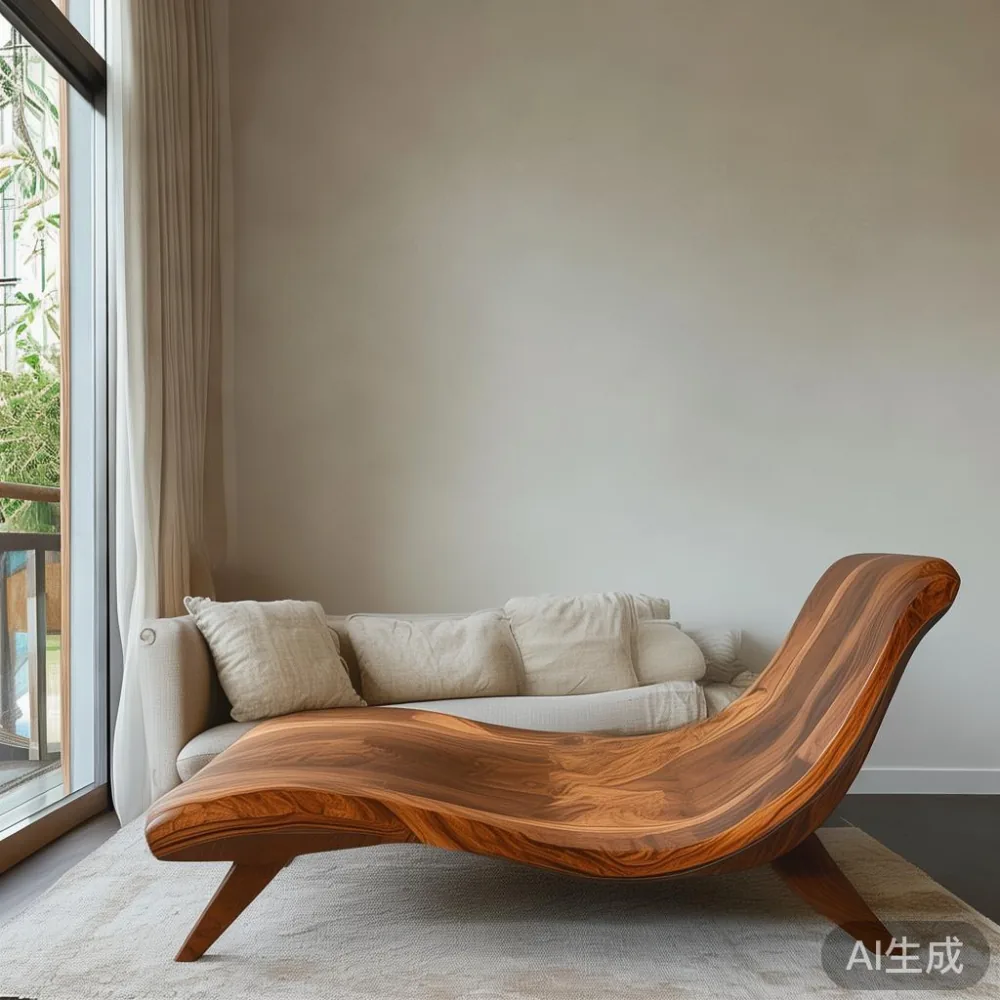
A solid wood chaise lounge, particularly one made from imported white oak, ash, or walnut with a kiln-dried frame, lands between S$2,800 and S$4,500 for a comparable silhouette, depending on upholstery. MIDHILL's factory direct pricing for a 195cm × 82cm solid oak chaise lounge with linen-blend cushioning comes in around S$3,200 landed, inclusive of marine-grade export packing. That's roughly 2.3× the veneer price.
The gap is real, but it's also the only honest number most buyers look at. Let's add GST: at 9% on the imported portion, a S$3,200 chaise lounge carries about S$240 in GST, versus S$100-ish on the S$1,200 veneer piece. Neither is nothing, but neither breaks the comparison.
How much does each chaise lounge actually cost per year over a five-year window?
Here's the math I walk buyers through, line by line:
Veneer chaise lounge — Year 0 to Year 5:
Purchase S$1,300 (mid-range Tampines example) + delivery S$120 + GST S$100 ≈ S$1,520 Year 0.
Year 2: corner chip repair kit S$40, plus 2 hours of your own labour.
Year 3: surface peeling, cannot be refinished because the laminate is paper-thin — full replacement required. New chaise lounge S$1,400, delivery S$120, disposal of old piece via HDB bulky refuse collection (free, but you wait 4 to 6 weeks for a slot in Punggol), so total Year 3 outlay S$1,520.
Year 5: replacement piece is now showing the same failure pattern, but you decide to sell it on Carousell for S$150 to a student starting uni. Net 5-year spend: S$1,520 + S$40 + S$1,520 − S$150 ≈ S$2,930.
Effective cost per year: about S$586 per year.
Solid wood chaise lounge — Year 0 to Year 5:
Purchase S$3,200 (MIDHILL solid oak landed) + delivery S$80 (lift-accessible HDB, free above the supplier's shipping threshold) + GST S$240 ≈ S$3,520 Year 0.
Year 2: light scuff, one can of hard wax oil S$25, applied over a Sunday afternoon.
Year 4: minor tightening of two joinery screws (the frame uses traditional mortise and tenon plus modern corner brackets), no cost — included in the supplier's after-sales support.
Year 5: nothing. The piece still has 80%+ of its original finish, and the supplier offers lifetime refinishing, which I exercised myself last year on a six-year-old MIDHILL chaise lounge in a colleague's Yishun condo — total cost S$0, plus S$35 in courier fees for the return trip.
Net 5-year spend: about S$3,580.
Effective cost per year: about S$716 per year.
At year five, the gap is real — S$716 vs S$586, roughly S$130 a year more for solid wood. Now stretch it.
Why does the calculus flip between year seven and year ten?
Push the comparison to year ten and the numbers reverse. Veneer chaise lounges rarely survive past one replacement cycle; even a well-cared-for unit shows visible delamination in Singapore's 28°C to 33°C range with 80% humidity year-round. By year ten, a buyer who started with veneer has purchased three chaise lounges, with two mid-cycle repairs:
3 × S$1,520 = S$4,560 in purchases, plus S$80 in repairs, minus S$200 in Carousell resale = S$4,440 net, or S$444/year.
Wait — that looks cheaper. But here's the missing variable: the replacement cycle disrupts your living room. Two moves of a 90kg piece down a 1.1m-wide corridor in a Punggol HDB, two disposal waits, two new deliveries. Time has a cost. And the second replacement is almost never identical to the first, so the room's look shifts.
Solid wood at year ten: same chaise lounge, two refinishing visits at S$35 courier each, S$120 in wax oil. Net 10-year spend: S$3,560 + S$70 + S$120 ≈ S$3,750, or S$375/year. Solid wood wins by S$70 a year — and the piece has another 10 to 15 years of useful life ahead of it, because solid oak and ash frames properly kiln-dried to 8–12% moisture content handle Singapore's humidity without warping, provided you keep them out of direct afternoon sun (which I learned the hard way when a south-facing window in my own place bleached an unprotected oak shelf within nine months).
What hidden costs do Singapore buyers underestimate?
Three costs that rarely make it into the showroom conversation but absolutely should:
Disposal and moving. A standard chaise lounge weighs 35 to 50 kg (veneer) or 60 to 95 kg (solid wood). Moving a solid wood piece costs more — typically S$120 to S$180 per move within the same estate, versus S$80 to S$100 for veneer. But solid wood needs half as many moves. The break-even sits at the second move.
Corridor and lift geometry. Older HDBs in Bedok and Tampines have corridor widths between 1.2m and 1.4m, and lifts measured at roughly 1.4m deep × 1.1m wide with a 600 kg load limit. A disassemblable solid wood chaise lounge (frame separates from base via four bolts, common in MIDHILL's export range) fits where a one-piece veneer piece often does not. This is why the supplier's specification sheet lists each component's dimensions separately — and why I always ask buyers to measure their lift door before ordering.
Refinishing vs replacing. Veneer cannot be sanded below 0.3mm without exposing the substrate. Solid wood can be sanded 2 to 4mm across its lifetime and re-oiled indefinitely. A S$35 courier-and-refinish job (the kind offered by makers with a working refinishing workshop — MIDHILL runs one in Foshan for international buyers) saves the cost of a new S$1,400 to S$3,200 chaise lounge. Over a decade, even one avoided replacement swings the comparison firmly toward solid wood.
Does the cost comparison change between an HDB flat and a private condo?
Slightly, but not in the direction most people expect. Condos in Punggol and the new launches around Tampines North have wider corridors (1.6m to 1.8m) and larger service lifts designed for move-ins, so delivery friction drops. The chaise lounge cost difference between veneer and solid wood narrows by about S$50 per cycle because delivery is easier. But condo buyers tend to hold pieces longer — resale HDB churn is roughly every 7 to 9 years, condo churn every 12 to 15 years — which means the solid wood chaise lounge sees more years of service under the same roof, amplifying its lifetime cost advantage.
For HDB upgraders in particular, a solid wood chaise lounge, bed frame, or dining table often becomes a resale asset rather than a disposal liability. Last quarter alone, three buyers I spoke with in Bedok Resale transactions reported keeping their solid wood pieces across two HDB moves; one kept a 12-year-old ash dining table through three.
How does style category affect what you actually pay for a chaise lounge?
Here's where the light luxury framing earns its place in the conversation. Buyers searching for French light luxury or French provincial for apartment interiors are typically drawn to curved silhouettes, cabriole-style legs (modified for structural honesty), and warm walnut or oak finishes — all of which are far more convincing in solid wood than in veneer. A printed laminate cannot fake the way light hits a quarter-sawn oak grain at 7pm on a Tampines evening. The premium for that authenticity in a chaise lounge sits around 15% to 25% above a standard solid wood price, but it survives every trend cycle from 2026 to 2031.
Buyers searching American light luxury lean toward cleaner lines, lower backs, and natural-finish ash — again a solid wood story. The post-modern light luxury crowd, which is the fastest-growing segment among younger Singapore condo owners in their early thirties, asks for slim profiles, often with a marble or sintered-stone side table integrated into the chaise lounge frame. Sintered stone tops add S$280 to S$450 to the chaise lounge cost, but they weigh 8 to 12 kg per panel and require two-person delivery — a logistical consideration in a sixth-floor walk-up in older HDB blocks without a lift.
Office and bedroom applications change the math further. A buyer asking about light luxury for office contexts usually means a chaise lounge for a home study or a director's room in a serviced office — heavier daily use, often with shoes and bags placed on it. Solid wood wins faster here because the wear surface is real wood, not printed paper. For bedroom use, the European light luxury for bedroom aesthetic pairs a chaise lounge with a coordinated bed frame and nightstand, and the cross-category consistency of solid wood grain (same species, same finish batch) is something veneer manufacturers cannot replicate across product lines.
For buyers researching how to style European sofa in room layouts — a question I get every week from homeowners working with their IDs — a solid wood chaise lounge anchors the seating group the way a solid wood dining table anchors the dining room. Style questions aside, the cost math doesn't care about category: the longer the ownership horizon, the more solid wood wins.
Is a solid wood chaise lounge worth the extra upfront cost?
For a buyer planning to keep the piece five years or less, and willing to accept one full replacement cycle, veneer is honestly the rational choice. The annualised cost is lower, the upfront cash outlay is lower, and the silhouette on Day 1 is nearly indistinguishable from solid wood to a casual observer.
For a buyer planning five to fifteen years in the same home — which describes the majority of HDB upgraders and most condo owners I speak with — solid wood is the rational choice by year six or seven. The combination of refinishing availability, structural warranty (look for a 10-year warranty on frame joinery as a baseline), and stable humidity performance in Singapore makes the higher upfront cost recover itself through avoided replacements.
My own test of the comparison sits with a colleague's six-year-old MIDHILL chaise lounge in a Yishun condo. She paid S$3,450 landed in 2020, refinished it once for free under the lifetime refinishing program in 2024, and is still using it daily in 2026. Annualised cost over six years: S$575. A comparable veneer buyer in the same period would have replaced the chaise lounge once and is on track for the second replacement by year seven.
What should you check before ordering either option?
Six questions to ask any chaise lounge supplier, in this order:
1. What is the core material under the surface, in millimetres? Solid wood means 18 to 25mm hardwood throughout the load-bearing frame. Veneer means MDF or particleboard with 0.3 to 0.6mm laminate.
2. Is the frame joinery mortise and tenon, dowel, or biscuit? For solid wood, mortise and tenon with corner brackets is the answer you want.
3. What is the moisture content at delivery? Properly kiln-dried solid wood sits between 8% and 12%. Anything above 14% will move in Singapore's humidity.
4. Can the piece be disassembled for HDB lift delivery? A "no" answer eliminates half of Bedok and Tampines.
5. Does the warranty cover structural joinery for 10 years, and is refinishing offered? A "yes" to both points to a maker who has been doing this long enough to stand behind it — MIDHILL's 10-year structural warranty and lifetime refinishing program is one example among several established Foshan factory exporters.
6. What is the per-component weight in kg? If the supplier won't tell you, walk away. Reputable makers list every component weight because their logistics team uses that data weekly.
Buyers comparing across style categories — searching for top 10 Industrial furniture lists, evaluating best European sofa for 2026 write-ups, weighing a wardrobe or nightstand in matching solid wood — should run the same six questions across every piece in the room. The numbers shift slightly with scale, but the cost logic holds: a solid wood dining table, bed frame, wardrobe, or nightstand follows the same five-year curve as a chaise lounge, just with bigger absolute numbers and longer ownership horizons.
Frequently asked questions Singapore buyers ask before committing
Can a solid wood chaise lounge fit into my Bedok HDB lift?
Yes, if the supplier designs the frame to break down into 2 or 3 components, each under 35 kg and under 1.5m on the longest side. Lift doors in older HDB blocks measure roughly 0.9m wide, and the internal cabin is about 1.4m deep. Always measure your specific block — lift retrofits in Punggol and Tampines North are slightly larger.
How long does delivery from a Foshan factory take to Singapore?
Sea freight to Singapore port averages 7 to 10 days, plus 3 to 5 days for customs clearance and last-mile delivery. Plan a 14 to 21 day window from order to doorstep.
Does GST apply to imported solid wood furniture?
Yes, at 9% on the CIF value (cost, insurance, freight) for orders above S$400 in declared value. This is non-negotiable and collected by the supplier or your freight forwarder before release.
Will solid wood crack in Singapore's humidity?
Properly kiln-dried wood (8 to 12% moisture content) acclimatises to Singapore's 28 to 33°C and 75 to 85% humidity without cracking. Avoid pieces stored outdoors or in non-air-conditioned warehouses for extended periods before delivery.
Can I refinish the chaise lounge myself, or must I ship it back?
Surface scratches and worn patches can be handled at home with hard wax oil (S$25 to S$45 per tin, available at hardware chains). Full refinishing — sanding and re-oiling — is best done by the maker's workshop because the finish needs controlled conditions. Return shipping from Singapore to a Foshan factory refinishing service runs about S$60 to S$90 one-way.
How do I make the final call between veneer and solid wood?
Take the total cost you actually pay, divide by the years you'll keep the piece, and add S$50 a year for the mental load of knowing the surface might peel. If you're moving within three years, veneer wins on the spreadsheet and there's no shame in choosing it. If you're settling in for a decade or more — and you can measure your lift, accept a 14 to 21 day delivery window, and find a supplier with a real structural warranty — a solid wood chaise lounge from an established Foshan factory exporter pays you back in years six through fifteen, in refinishing credits you never expected to use, and in a room that still looks correct when the third Carousell listing of your friend's replacement cycle goes live.