What Actually Drives the Price of Solid Wood Furniture in Singapore
Walk into any Tampines HDB living room after a BTO handover and you will see the same puzzle: a 90 cm-wide corridor, a 2.1 m ceiling, a lift that maxes out at 1.6 m deep, and a family trying to fit a proper sofa, a bed frame, and a dining table into a space that was drawn on a grid, not lived in. After fifteen years moving flat-pack cartons up Bedok walk-ups and watching solid wood dining tables survive three moves while engineered-board wardrobes chip at the edges, I have learned one thing: the sticker price on a piece of furniture tells you roughly half the story. The other half lives inside the timber, the joinery, the finish, and the logistics chain that got the piece from a 28,000 m² Foshan workshop to your Punggol corridor.

At MIDHILL, where we have been cutting solid wood since 2008 and shipping to more than fifteen countries from the same Foshan base, we get asked almost every week why a solid wood sofa costs S$1,680 while a similar-looking one downstairs costs S$690. The honest answer takes a few hundred words. Let me give them to you.
Is the wood really solid, and what species is it?
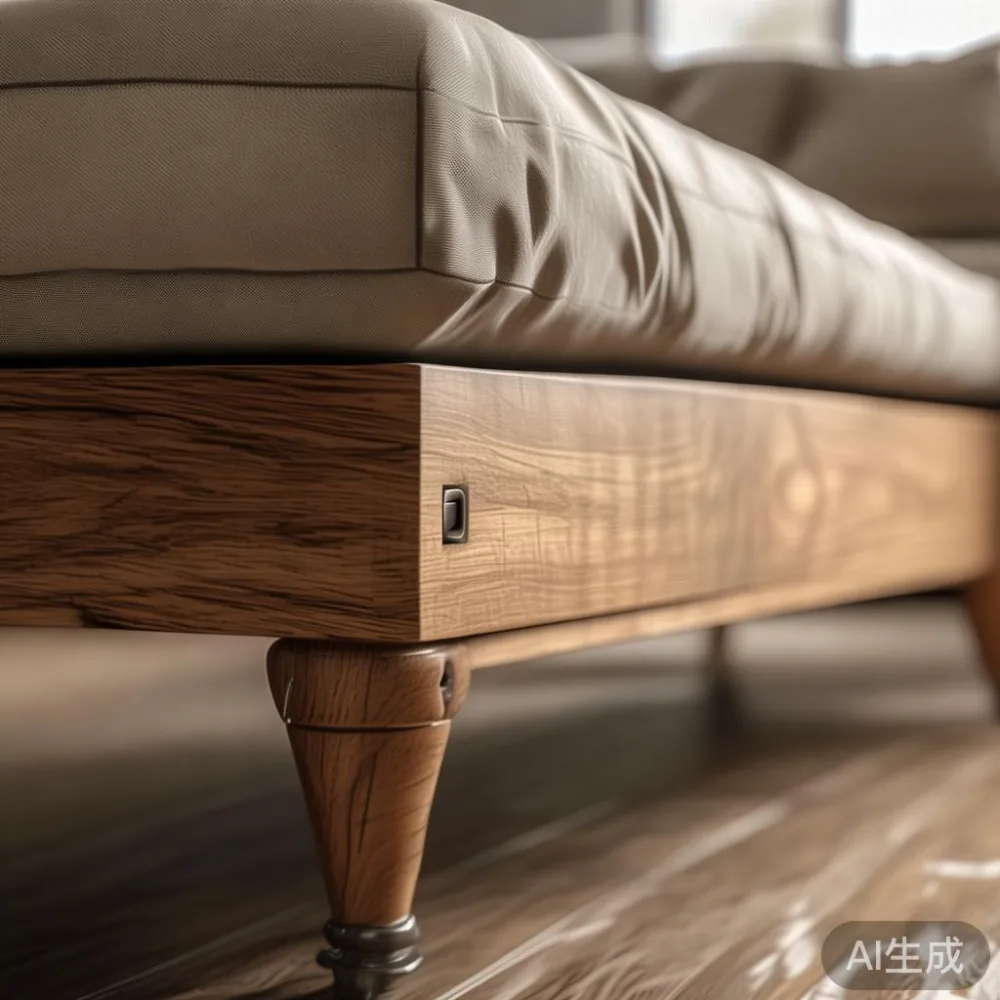
The single largest cost driver in any piece of solid wood furniture is the timber itself, and it is also the easiest place for a buyer to be misled. A "solid wood" label in Singapore can legally cover everything from a single 4 cm-thick oak slab to a frame built from 2 cm ash with hidden MDF panels in the doors. Genuine solid wood furniture uses boards cut from a single piece of timber for every load-bearing part: the legs of a chaise lounge, the aprons of a dining table, the side rails of a bed frame.
Species matters because density, not appearance, is what you are paying for. White oak at roughly 750 kg/m³ costs meaningfully more than rubberwood at 620 kg/m³, and both cost more than the engineered cores often hidden behind a 0.6 mm walnut veneer. When I visited the MIDHILL Foshan yard last month, the foreman walked me past stacks of North American FAS-grade oak, each board stickered and dried to 8–10% moisture content, then past bunks of ash priced about 18% lower per cubic metre. A solid wood wardrobe in oak will retail around S$1,950 in Singapore; the same silhouette in ash lands closer to S$1,620. That gap is almost entirely the timber.
For Singapore's humidity, which sits at 78–85% RH for nine months of the year, the species choice is not just cosmetic. Oak and teak hold their geometry through the wet season. Cheaper softwoods move more, which is why a S$480 pine bed frame can creak by month eight while a properly dried oak frame stays quiet for a decade.
How much of the cost is hidden in the joinery and hardware?
Run your hand under a well-made solid wood dining table. You should feel smooth mortise-and-tenon joints, corner blocks glued and screwed at 45°, and drawer boxes with dovetailed fronts rather than stapled MDF. Each of those choices adds labour hours and rejects imperfect timber, which is expensive.
By the piece, the math roughly looks like this on a S$2,200 dining set:
- Raw timber (kiln-dried oak): about S$520
- Joinery labour, sanding, assembly: about S$380
- Finish (multi-coat water-based lacquer, sanding between coats): about S$180
- Hardware (soft-close Blum runners, solid brass hinges): about S$140
- Packaging, crating for export, sea freight to Singapore: about S$320
- GST, local handling, last-mile delivery up to your HDB: about S$210
- Brand margin and 10-year structural warranty reserve: about S$450
Now compare that to a S$790 table at a neighbourhood mall. The timber line is usually halved, the joinery replaced with dowels and cam locks, the runners swapped for friction slides, and the crating downgraded to a single cardboard wrap. None of that is a sin if the price is honest, but it does mean the table was engineered for a two-year life, not a ten-year one.
What is the best corner sofa for a small apartment?
For a small HDB or condo living room, the best corner sofa is a compact, three-seat chaise lounge with a solid wood internal frame, removable seat cushions at 12–14 cm thick, and an L-shape footprint no larger than 218 cm × 165 cm, which fits comfortably inside a standard 3.5 m × 3.8 m living room without blocking the corridor to the kitchen. Anything larger will eat the walkway between your dining table and your TV console, and anything with a metal webbing base will start squeaking by the second Chinese New Year.
Because most Singapore flats run on a 90–110 cm corridor grid, a modular chaise lounge you can split into two pieces for delivery is a quiet superpower. Two movers can carry each half into the lift without booking the service lift, which on weekends in Punggol can mean a four-hour wait. MIDHILL's solid wood sofa programme, for example, breaks its larger corner units into 110 kg max modules specifically so they clear a standard HDB lift door of 1.2 m × 2.1 m and survive a U-turn in a Bedok stairwell without a single scratch.
Does shipping from Foshan really add that much?
Yes, and it is the line item that surprises Singapore buyers most. A 2 m dining table crated for export weighs 95–110 kg. Sea freight from Shenzhen to Singapore Port runs about US$22–28 per cubic metre for shared-container LCL, plus US$60 for customs clearance and 9% GST on the landed value. For a single dining set that translates to roughly S$180–240 of freight before the carton even leaves the port.
Last-mile delivery inside Singapore is the second freight layer. A ground-floor HDB takes 20 minutes; a 12th-floor unit in a Tampines block with no service lift booked can take 90 minutes and adds about S$80 in man-hour charges. Most direct-from-factory sellers, including MIDHILL, absorb the freight above a S$350 order threshold, but the cost is still inside the price. Anyone quoting you S$200 below the market rate for a similar solid wood bed frame is almost certainly skipping the crating or shipping unassembled flat-pack, both of which shorten the life of the piece.
Why do some "solid wood" pieces still feel cheap after a year?
Because the wood was probably solid, just not dried properly, or finished with a single coat of NC lacquer that yellows under Singapore UV. A few rules I have picked up after watching friends refurbish their flats in Bedok Reservoir and Punggol Waterway:
- Ask for the moisture content reading at production. Anything above 12% MC for an indoor piece is a risk in our climate.
- Run a fingernail along an unseen edge. If the finish chips in a single flake, it is likely a single-coat sealer.
- Check the underside of a dining table or the back of a wardrobe. Workshops proud of their construction leave those surfaces clean; workshops that cut corners leave staples and exposed MDF.
- Weight matters. A genuine solid wood bed frame in queen size should weigh 55–70 kg. If the listing says 28 kg, the panels are veneers.
The finishing process alone can swing a dining table price by S$200–350. A seven-coat water-based lacquer with 220-grit sanding between each coat, then a final wax top, costs roughly three times a single-coat spray. It is also the difference between a table that looks alive after five years and one that looks tired after five months.
How does light-luxury design actually show up in the price?
Light luxury is a quiet category, not a loud one. French light luxury tends to favour slim 6–8 cm chair arms, brushed brass tipping, and travertine or sintered stone accents on a coffee table or sideboard top. American light luxury leans towards chunkier 12 cm profiles, oversized tufting on a chaise lounge headrest, and warm walnut tones. Post-modern light luxury mixes the two: a low-profile solid wood sofa frame with marble table tops, slimline brass legs, and asymmetrical nightstands that read as sculptural rather than matched.
None of those silhouettes require exotic timber. They do require tighter tolerances. A sintered stone top on a sideboard, for example, needs an MDF or plywood sub-frame with a 2 mm expansion gap on every edge, otherwise the slab will crack in our humidity within six months. This is one of the underrated reasons buyers ask about Post-modern sintered stone assembly difficulty before they commit: the joinery, the substrate, the room for thermal movement, and the specialised adhesive all sit inside that line item.
A small note on marble table tops. Real Carrara marble is gorgeous and unforgiving. It stains from soy sauce in under 20 minutes and needs sealing twice a year. Sintered stone gives you 95% of the same look, costs about 40% less per square metre, and shrugs off red wine. For a HDB dining table that doubles as a homework station, sintered stone is the honest choice.
What should a Singapore buyer actually compare before paying?
Put four numbers side by side before you decide:
- Timber species and board thickness on every load-bearing face, written on the spec sheet, not implied.
- Warranty length on the frame. A 10-year structural warranty is a strong signal; a 1-year warranty is a confession.
- Weight and module count for delivery. Can two movers carry it into your lift?
- Total landed cost including GST, delivery above the third floor without a service lift, and any assembly fee.
Then check the soft terms: do they offer lifetime refinishing on a solid wood dining table or bed frame, or do you have to throw the piece away when the lacquer dulls in year six? At MIDHILL we refinish our own pieces for the cost of transport only, which works out to roughly S$180–260 for a dining table sanded and re-lacquered to factory standard. That single policy can save a S$2,200 purchase from becoming landfill in 2032.
So what is a fair price for a solid wood chaise lounge in Singapore right now?
Based on what is sitting in the MIDHILL showroom and what is comparable across Tampines, Bedok, and Punggol delivery runs:
- Solid oak chaise lounge module, 165 cm, with removable cushion: S$1,680–2,150
- Solid ash chaise lounge, same footprint, slightly lighter grain: S$1,420–1,780
- Solid wood bed frame, queen, oak with underbed slats: S$1,250–1,650
- Solid wood dining table, 1.6 m, seats four: S$1,380–1,950
- Solid wood wardrobe, 180 cm three-door: S$1,950–2,650
- Solid wood nightstand, two-drawer, oak: S$380–520
Anything more than 25% below those bands and you are probably looking at veneer over engineered board, single-coat finishing, or a one-year warranty that quietly excludes structural failure. Anything 30% above and you are paying showroom rent in Orchard, not better timber.
Where does this leave a buyer who just wants one good sofa?
Buy the frame, not the cushions. Cushions compress and can be replaced for S$220–380 every five to seven years. The frame is what carries a 10-year warranty and a lifetime of refinishing. If you can only afford one upgrade, put your money into a solid wood sofa or chaise lounge with a kiln-dried oak or ash skeleton, mortise-and-tenon corners, and a fabric you can unzip and wash. Skip the marble table top for now; a sintered stone version on a slim oak base gives you the same visual at 40% of the weight and a fraction of the maintenance.
For a Singapore HDB or condo, the honest math is simple. Pay once for solid wood furniture that can be moved twice, refinished once, and inherited once. Pay twice and you are just renting the look from yourself.